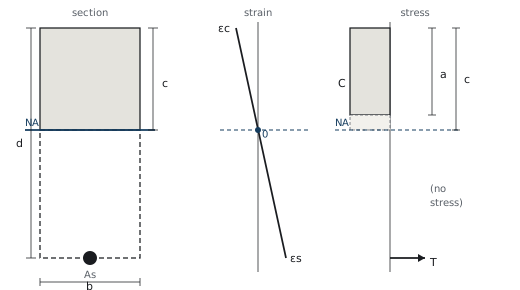
Here is a question that bothered me for years, and that I have never seen explained as plainly as it deserves. In the standard strength analysis of a reinforced concrete beam, we draw the equivalent rectangular stress block at the top, a single layer of steel in tension near the bottom, and a tall region of cracked concrete carrying no stress at all. The neutral axis sits below the bottom of that rectangular block. The block is a force-equivalent abstraction with depth a equal to beta-one times c, chosen so that its resultant matches the real compressive force. Nothing about its depth marks the boundary of the compressed material. The real compression zone runs all the way down to the neutral axis, and only below that does the cracked, stressless region begin. So why is the neutral axis at that particular depth?
If you have ever quietly wondered the same thing and simply accepted the formula, this one is for you.
The mistake inside the question
The confusion comes from thinking the neutral axis is located where the stress is zero. The neutral axis is the line where the strain is zero. Those sound like the same thing, and in a simple uniform material they happen to coincide, which is why the distinction is easy to lose. In a section made of materials that behave differently the two locations separate, and keeping them distinct resolves the whole puzzle.
Strain is the variable you can rely on
The reliable fact in bending is that plane sections remain plane. The cross-section rotates about some axis, and the strain varies linearly from that axis: zero at the axis, growing in proportion to distance away from it, compression on one side and tension on the other. That linear strain profile is continuous and unbroken across the entire depth of the section, including straight through the cracked concrete. The cracks do not interrupt the strain. They interrupt the stress.
That is the essential point. In the cracked region, the strain is whatever the linear profile says it is, but the stress is zero, because cracked concrete cannot carry tension. The material is strained and generates no stress in response. There is no contradiction. Strain is geometric and continuous; stress is the material’s response, and a cracked material responds with nothing.
Why the axis sits where it sits
So where does the neutral axis actually sit? It sits wherever it has to in order to satisfy equilibrium: the total compression force above it must equal the total tension force below it. The concrete in compression supplies the compression. The steel supplies the tension. The cracked concrete in between supplies nothing in either direction, so it does not enter the force balance at all. When you write down that the total compression carried by the concrete equals the tension in the steel and solve for the location that makes it true, the answer comes out at the bottom of the compression zone, which is the neutral axis. The forces balance at that depth, and that is the entire reason the axis is there. The large cracked region is irrelevant to the force balance precisely because it carries no force.
The neutral axis is the depth at which the strain is zero, and equilibrium fixes its position. Where the cracking happens to stop has nothing to do with it.
Why this is worth understanding deeply
This is more than a teaching curiosity. The same reasoning, strain stays linear and continuous, stress follows the material, and the axis is located by equilibrium, is exactly what you need to reason correctly about any section built from parts that carry load differently. Composite and partially composite systems, mixed-material members, anything where one component takes compression and another takes tension across an interface: they all follow from the same first-principles reasoning. Get the cracked concrete case truly clear, and a surprising amount of harder structural behavior stops being mysterious. This kind of first-principles reasoning is at the center of my structural engineering work.